
Choosing the right sunblinds Brighton homeowners can rely on is about more than blocking out the sun. The right system should reduce harsh glare, help manage indoor heat, and preserve the natural light or garden views you want to keep. A west-facing living room, an upstairs bedroom and a glazed alfresco area can all have different shading requirements, so choosing the same fabric and blind style for every window may not deliver the best result.
Before investing in new sunblinds, consider when direct sunlight reaches each window, how much visibility you want to retain, and whether privacy is important during the day or after dark. From breathable sunscreen mesh and traditional canvas to more opaque fabrics, vertical sunblinds and adjustable drop-arm awnings, each option offers different benefits.
This guide explains how to match the right combination of fabric, coverage, and operating system to your home, so you can compare options confidently before requesting a quote.
Start with when and where the sun hits
Observe the affected room over several days. Note when glare appears, where the sun falls, and whether you still need daylight at that time. Orientation matters, but trees, nearby buildings, eaves, and glazing also affect exposure.
- East-facing windows: Look at morning glare and low-angle sunlight, especially in bedrooms and breakfast areas.
- North-facing windows: Consider adjustable shading that can reduce stronger summer sun without automatically losing useful winter light.
- West-facing windows: Check late-afternoon sun, when glare may reach living rooms and the sun may sit low in the sky.
- South-facing windows: Check whether glare is actually the problem before selecting a strong external shade; daylight and ventilation may be more important.
External shading intercepts sunlight before it reaches the glass, but results depend on fabric, installation, coverage and orientation. For independent background, see the Australian Government’s guidance on windows and home comfort.
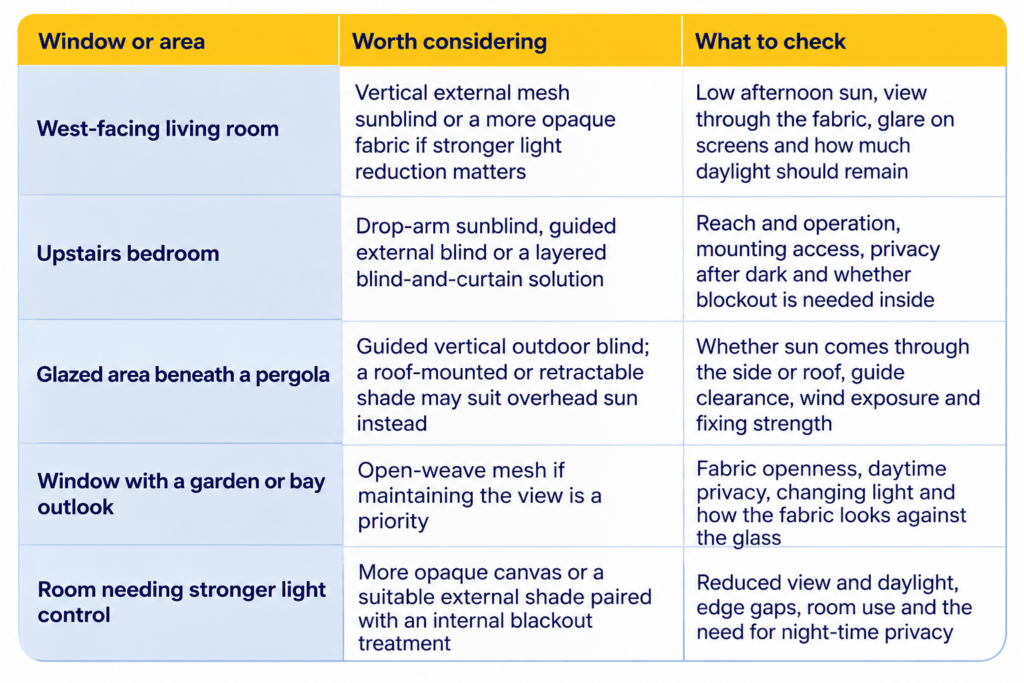
Which sunblind suits each window situation?
You may use this table to shortlist options; confirm the opening, fixings, access and fabric specifications with an installer.
Mesh, canvas or opaque fabric: what is the difference?
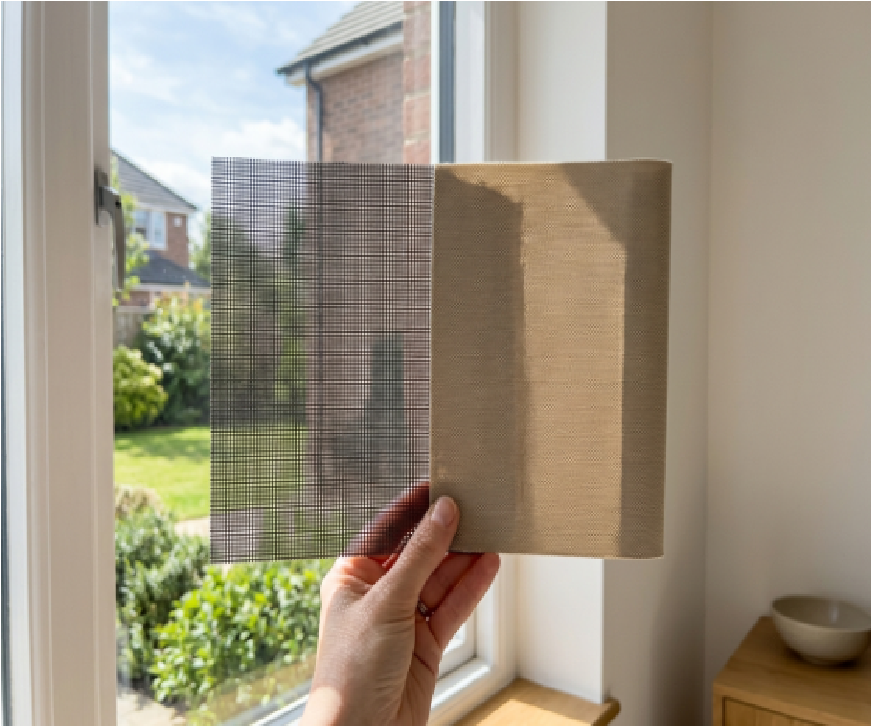
Fabric is more than a colour choice. Weave, openness, backing and intended use affect light, visibility and the feel of a room. Review samples in daylight against the actual window where possible.
Mesh and sunscreen fabric
Mesh softens glare while retaining some outward visibility. Openness varies: a more open weave generally preserves more of the view, while a tighter weave can reduce more light and visibility. Fabric colour also affects perceived brightness and the view.
For outdoor blinds Melbourne projects, compare mesh where garden or courtyard sightlines matter. It does not guarantee privacy; check the maker’s sun, wind and exposure specifications.
Canvas and acrylic awning fabrics
Fabric suitability depends on the blind style and mechanism. For example, traditional canvas gives a more solid, classic appearance and may suit stronger shade with reduced visibility. Outdoor acrylic fabrics are another option for compatible systems.
When comparing canvas blinds Melbourne options, consider colour, backing, texture and remaining daylight. More opaque fabric may provide stronger shade but may make a window feel enclosed.
Opaque and blockout options
For a darker bedroom or stronger screening, compare opaque external fabric with an internal blockout blind. Edge gaps can still let light in. Layering external shade with an internal treatment may offer more control between daytime and bedtime.
Daytime privacy is not the same as night-time privacy
Sunscreen mesh may limit views into a room in some daytime conditions, but it does not guarantee privacy after dark. When interior lights are on, people outside may see through some fabrics depending on sightlines and relative brightness.
If the window faces a footpath or neighbouring home, decide whether daytime screening is enough. For evening privacy, consider curtains or an opaque internal layer. Ask for a sample and assess it against a lit room if possible.
Vertical sunblind, drop-arm awning or another system?
The mechanism matters because sun can arrive at different angles. However, though search terms overlap, the products are not interchangeable.
- Sunblinds Melbourne often refers to external window-mounted systems
- Roller blinds in Melbourne commonly refer to internal fabric rollers
- Outdoor awnings in Melbourne often centre on overhead or projecting shade.
When comparing blinds Brighton options with awnings Brighton options, clarify whether the treatment sits inside the glass, in front of the window, or above a patio. This makes the quote more specific and avoids choosing by product name alone.
Vertical or guided external sunblind
A vertical sunblind lowers in front of the opening, making it worth considering when side-on sun reaches a window. Guided systems help keep the blind aligned where the configuration is suitable. Also, compare external blinds Melbourne options if retaining some outlook matters.
Drop-arm awning
A drop-arm awning projects outward as it lowers. Depending on its angle, it may shade the upper window while retaining some view or extend further against low-angle sun. Check arm clearance, fixing points, and window suitability, especially upstairs.
Folding-arm or retractable awning
A folding-arm awning is generally better suited to overhead shade across a patio than screening a vertical window. Retractable awnings Melbourne options may open the area when shade is not needed, but projection, mountings and wind exposure must be assessed.
For “awnings Brighton” enquiries, identify whether sun is coming through a window, across an outdoor area or through a pergola roof. Vertical blinds, drop-arm awnings and overhead awnings solve different problems.
Three Brighton scenarios to help narrow the choice
Scenario 1: West-facing living room
Imagine afternoon sun landing on the television and sofa while the garden view matters. Compare mesh fabrics with different openness levels. If glare remains strong, sample a tighter weave before choosing full blockout, and check whether the blind covers the actual sun angle.
Scenario 2: Upstairs bedroom
For a high window, access matters as much as fabric. Compare a drop-arm or guided vertical system and confirm operation and maintenance access. If darkness and night privacy matter, external shading may not replace internal blockout blinds or curtains.
Scenario 3: Glazed space under a pergola
If low-angle sun enters from the side, a guided vertical blind may help. For sun coming through the roof, investigate a suitable roof shade or retractable system. Ask the installer to assess structure, fixing points, exposure and fabric suitability.
Sunblinds Brighton: buyer checklist before you request a quote
Record the sun pattern: Note the window direction and the times glare or direct sun becomes uncomfortable.
Define the priority: Choose your main aim – glare reduction, preserving the view, stronger shade, privacy or a mix.
Compare fabrics in daylight: Review mesh openness, canvas or acrylic options, colour, backing, and the amount of light that remains.
Check privacy after dark: Decide whether an internal blind or curtain is also needed.
Match mechanism to geometry: Confirm if the opening needs a vertical guided blind, drop-arm awning or overhead retractable shade.
Inspect the fixing area: Record window dimensions and nearby sills, gutters, downpipes, screens, rooflines, and other obstructions.
Confirm exposure suitability: Ask for relevant product specifications and operating limits for the actual site.
Choose operation: Compare manual and motorised control, including any wiring, remote, sensor, or automation requirements.
Get a written scope: Ask for fabric, mechanism, measurements, installation, controls, exclusions, and warranty terms to be clear.
What about motorised blinds and awnings?
Motorisation is worth considering for high, wide, or frequently adjusted blinds. For an accessible window that rarely changes, manual operation may be enough. When comparing motorised blinds Melbourne or motorised awnings Melbourne options, check power, controls, compatibility and installation; motorisation alone does not improve shade performance.
Confirm whether controls use a remote, wall switch or app, and whether timers or sun and wind sensors are compatible. Follow the manufacturer’s operating limits at exposed sites; sensors do not replace safe use.
Explore sunblinds and awnings for your Brighton home
The best system solves your light problem without removing more daylight or view than you want to lose. Shortlist affected windows, record when the sun causes trouble, and compare fabric samples before choosing a mechanism.
You may also check out these sunblinds, SunScreen mesh blinds, and drop-arm awnings options for further reference. However, for overhead shade, compare folding-arm awnings and blinds in Camberwell. But remember, a site assessment can always confirm the fixing conditions and suitable configuration. If you are ready, you may also request a consultation and quote.