
Choosing blinds Rowville homeowners might need starts with one question: where is the problem happening? A bright lounge, a bedroom needing privacy, and an exposed alfresco may each need a different solution. Indoor blinds manage light and privacy after it reaches the glass; external blinds and awnings shade from outside or screen an open area.
The right choice depends on the opening, sun direction, desired airflow and visibility, and whether the space is enclosed or exposed. Check out this guide to compare options before arranging measurements or a quote.
For anyone comparing blinds Melbourne options, start with the location and job to be done rather than assuming every product category is interchangeable.
Indoor vs outdoor blinds: what is the difference?
Indoor blinds sit inside the window and are mainly used for privacy, glare control, light filtering, and room styling. Though “Roller Blinds Melbourne” searches often point to an internal window covering, roller blinds are a straightforward choice for bedrooms and living areas, while blockout fabrics can darken a room. These are examples of internal blinds in Melbourne options. Remember, a good fit matters because gaps can admit light; indoor blinds are not designed for rain or outdoor wind.
External blinds sit outside the glass or span an outdoor opening. By shading the glass before direct sunlight reaches it, they can reduce glare on the window and help manage solar heat.
Outdoor systems may use sunscreen mesh for filtered light and a view, or clear PVC where retaining the view and limiting wind-driven rain are priorities. Performance depends on the product and installation; no blind makes an open alfresco fully weatherproof.
An awning projects overhead but usually leaves sides open. A vertical blind is more suitable when low afternoon sun or wind enters from the side.
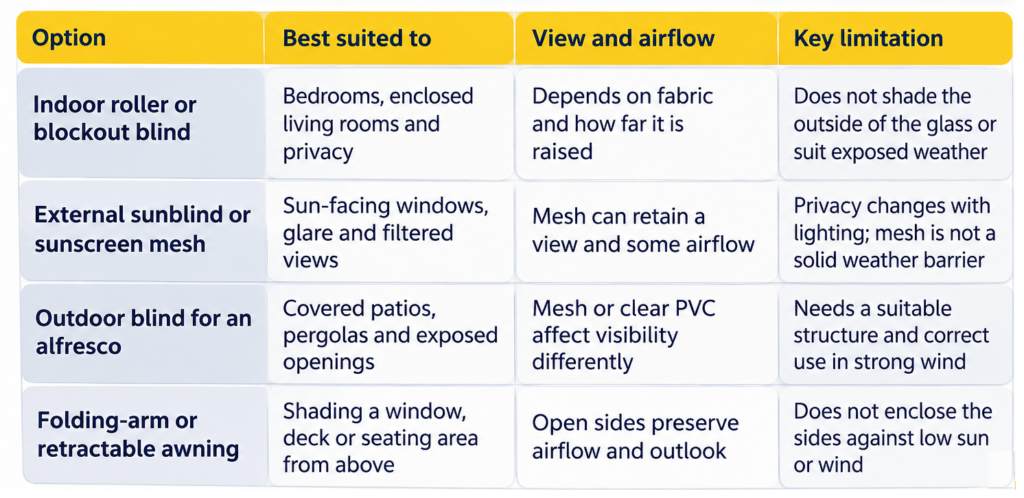
Note: Treat this table as a shortlist, not a performance guarantee. Product labels can overlap, and a “sunblind” or “outdoor blind” may refer to different hardware. Before comparing quotes, confirm the material, installation location, operating limits and intended use in writing.
Which blinds suit each part of a Rowville home?
Bedrooms: prioritise privacy and light control
For a bedroom, start with how dark you want the room and when you need privacy. A well-fitted internal blockout blind can help create a darker sleeping environment. If direct sun heats the room, external shading may help stop it reaching the glass. Combining outside shade with an indoor blind can provide both daytime sun control and night-time privacy.
Living rooms: manage glare without losing the view
For a living room with a garden outlook, sunscreen mesh or an external sunblind may reduce harsh glare while keeping some visibility. Fabric openness, colour and the brightness indoors compared with outdoors affect how clearly you can see through it. If the priority is evening privacy, an internal blind may still be needed. Check the room at the time glare is worst instead of selecting a fabric from a small sample alone.
Large windows and west-facing glass: shade before the sun hits
Large panes and west-facing windows can receive strong afternoon sun. Internal blinds control incoming light, while external shading can filter sunlight before it reaches the glass. So, compare vertical external blinds, sunblinds in Melbourne options, or an awning for the best decision. However, orientation, trees, eaves and nearby buildings may affect the shade required. For further guidance on window-focused selection, you may check out the guide to choosing sunblinds in Melbourne.
Sliding doors: keep access and operation practical
Keep the door handle, track and garden access clear. An internal roller blind can suit an enclosed room; an external sunscreen blind can control glare across the glass. If doors open to a covered alfresco, outdoor blinds fitted to the patio structure may suit the outer opening.
Alfresco and pergola areas: decide whether you need shade or enclosure
For overhead sun, compare outdoor awnings Melbourne options such as retractable awnings Melbourne or folding arm awnings Melbourne; they shade from above but leave sides open. For wind, low sun or sideways drizzle, vertical outdoor blinds may fit better.
Mesh filters sun and retains some airflow; clear PVC keeps more of the view while limiting wind-driven rain in a suitable covered area. So, choose pergola blinds Melbourne systems to suit the structure and exposure. Also, do not forget to check out the patio blinds guide for more outdoor-system detail.
Use this quick decision checklist
- The room needs privacy or darkness: Consider an internal blind with a suitable privacy or blockout fabric.
- Sunlight is heating the room through the glass: Investigate external shading such as a sunblind, sunscreen mesh or awning.
- You want to see the garden while reducing glare: Compare sunscreen mesh samples and check visibility in bright daylight.
- Wind or light rain comes into a covered alfresco: Consider an outdoor blind designed for the opening and exposure.
- You mainly need shade above a deck or window: Compare a retractable or folding-arm awning before enclosing the sides.
- You need privacy both day and night: Check whether a layered indoor-and-outdoor approach is more suitable than a single screen.
- The opening is wide, high, or used frequently: Compare manual and motorised operation, including access to power and controls.
Note: Use this as a starting point; confirm the structure, mounting surface, and product operating guidance.
Key factors to compare before you choose
Privacy and visibility
Privacy depends on lighting as well as fabric. Mesh that limits views indoors during daylight may offer less privacy at night with lights on. Check samples from both sides and consider an opaque or internal blind if privacy is essential.
Heat, glare and orientation
Record the window direction and when direct sun enters. Low-angle sun may need vertical shading; overhead awnings can help with higher-angle sun. Shading, glazing and ventilation work together, so one blind may not solve every comfort issue. For more guidance on orientation and seasonal shading, see the Australian Government’s YourHome shading guide.
Airflow and weather exposure
Mesh usually allows more airflow than clear PVC, but offers a different level of wind and rain protection. Decide whether you want open-air flow, filtered light or a more sheltered alfresco. Blinds do not replace a roof or suitable drainage.
Manual or motorised operation
Manual operation may suit a small, accessible window. Motorised blinds in Melbourne options are worth comparing for large or high openings and frequently used systems. Make sure you ask about power access, controls, grouped operation, and what happens during an outage.
Appearance, cleaning and maintenance
Compare fabric colour, frame finish and how the blind looks when retracted. Outdoor products collect dust and pollen, so ask about suitable cleaning methods and follow the manufacturer’s care advice.
Can you combine indoor blinds with outdoor shading?
Yes. Layering is often sensible when a home has several different problems. External shading can moderate direct sun at a west-facing living-room window; an internal blind can provide privacy in the evening; and outdoor blinds can make the covered alfresco more comfortable when the wind picks up. These systems do different jobs, so combining them does not mean you have chosen the wrong one.
Also, set priorities room by room. Start with the most uncomfortable openings, then coordinate colour, sightlines and controls. When comparing outdoor blinds in Melbourne or external blinds in Melbourne, ask what each system will improve, and what it will not do.
What to prepare before requesting a measure and quote
List each opening, take photos from inside and outside, and note approximate dimensions, sun direction, glare timing, privacy needs, and desired airflow. For an alfresco, include the roof type, posts, nearby doors, and wind exposure.
A professional measurement should confirm mounting surfaces, clearances, controls, and suitability. Also, ask for samples, care instructions, warranty terms, and a written scope, and check relevant requirements before altering a shared boundary or regulated structure.
Frequently asked questions
Find a shade solution that fits your Rowville home
Before choosing indoor blinds, external sunblinds, pergola blinds or an awning, identify the main issue at each opening: privacy, glare, heat, airflow or weather exposure. A site-specific assessment can confirm what suits your structure and routine.
If you are planning a shade upgrade in Rowville, arrange a measure and quote to discuss openings, exposure and privacy, or you may also review the local blinds and awnings service area when narrowing down next steps. Bring your photos and priorities so options can be compared against your home, not appearance alone.
Remember, whether the search is for blinds Bayswater, blinds Vermont, or blinds in Rowville, the same rule applies: orientation and opening type matter more than suburb alone.