
Motorised retractable awnings in Melbourne cost between $1,600 and $6,500 installed for most residential applications. They’re worth it — particularly for north and west-facing Melbourne outdoor areas — providing on-demand shade, smart-home integration, and automatic wind protection. The best motor brands for Melbourne conditions are Somfy and Rollease Acmeda, both of which offer wind and sun sensor compatibility. Yes, they work during power outages (manual override or battery motor options). And no, most standard residential installations don’t need a council permit.
If you’re trying to work out whether a motorised or retractable awning is the right move for your Melbourne home or business — you’ve landed in the right spot. There’s a lot of noise out there, and honestly, a lot of outdated information. Prices quoted online are frequently years behind the market, motor comparisons are often biased towards whatever the installer carries, and the smart-home integration story is told nowhere near well enough.
This guide cuts through all of that. We’ll cover the full picture: what retractable awnings actually are, the real cost of going motorised, which motor brands hold up best in Melbourne conditions, how smart-home integration works in practice, and when a canopy awning or commercial awning makes more sense than a folding arm system. Let’s get into it.
What Are Retractable Awnings & Why Are They Perfect for Melbourne?
Retractable awnings are wall-mounted or roof-mounted shade structures that extend and retract on demand — typically via a hand crank (manual) or electric motor (motorised). The defining characteristic is flexibility: unlike a fixed pergola roof or shade sail, a retractable awning gives you full control over when you want shade and when you want open sky.
For Melbourne specifically, that flexibility is more than a nice-to-have — it’s genuinely practical. Melbourne’s Bureau of Meteorology data consistently shows the city averages 2,200+ hours of sunshine annually, while simultaneously being famous for dramatic weather swings — 40°C days followed by 16°C the next morning, summer UV index readings of 11–13, and north-westerly storm gusts reaching 70–90 km/h. A fixed shade structure handles one extreme; a quality retractable awning handles all of them.
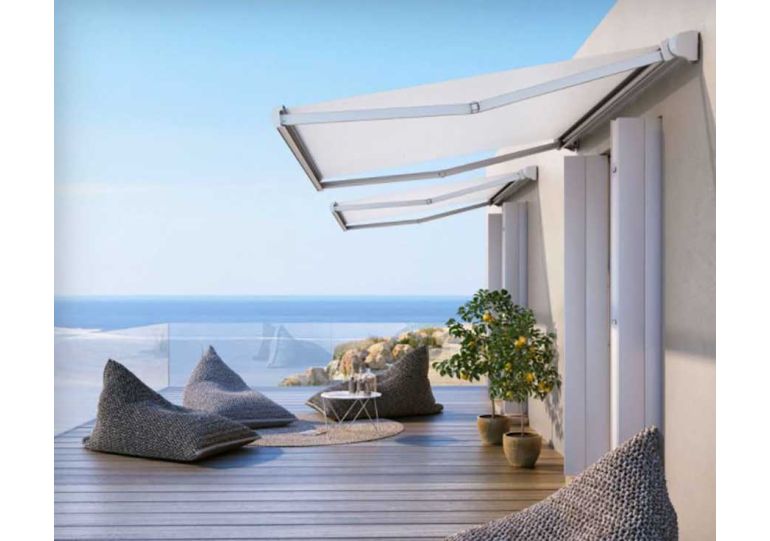
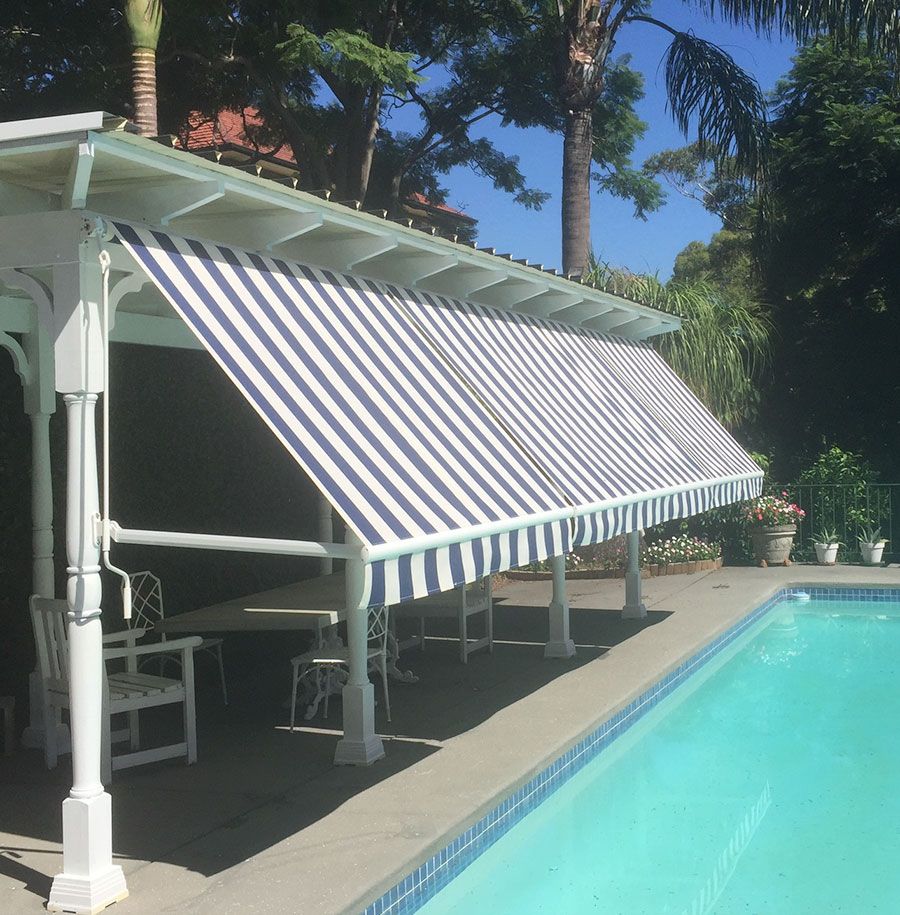
Retractable awnings extend on demand and retract fully when not needed — the ideal shade solution for Melbourne’s famously variable climate.
The Most Common Types of Retractable Awnings in Melbourne
“Retractable awning” is actually a category — and within it sit several distinct product types that suit different applications. Here’s a plain-English breakdown:
- Folding arm awnings (the most popular): Wall-mounted with articulated support arms that fold away when retracted. No support posts required. Ideal for decks, patios, and alfresco areas. Available in spans from 1.5m up to 10m+ wide.
- Cassette awnings: A premium variant where the fabric and arms retract into a fully enclosed aluminium housing when not in use — protecting the mechanism and fabric from UV degradation and weather. Most popular in architecturally-designed Melbourne homes.
- Canopy awnings: Fixed-front retractable systems — the front bar is stationary while the fabric extends and retracts. Common in commercial applications, older residential homes, and above windows and shopfronts.
- Lateral arm awnings: Side-mounted retractable screens providing lateral sun and wind protection — typically used alongside a folding arm awning to create a fully enclosed outdoor room.
- Pergola retractable roofs: Motorised fabric systems that retract along tracks within an existing pergola structure — different from a standalone awning but increasingly popular in Melbourne’s outdoor room renovation market.
Motorised Awnings Melbourne: Are They Actually Worth the Extra Cost?
The upgrade from manual to motorised awnings is the most common question our Melbourne customers ask — usually from someone who’s stood on a ladder trying to crank an oversized awning in the wind at least once. Here’s the unvarnished truth about motorisation:
The honest case for motorised: If your awning is wider than 4 metres, faces north or west, is installed above head height, or belongs to someone with limited mobility — motorisation isn’t a luxury, it’s genuinely the smarter choice. The payback comes through convenience, longevity (less physical stress on the mechanism from correct operation), and wind sensor protection.
What Motorisation Actually Adds to a Retractable Awning
- One-touch or remote operation — wall switch, handheld remote, or smartphone app
- Wind sensor integration — awning automatically retracts when wind speed exceeds your threshold (typically 40–50 km/h), protecting fabric and mechanism from storm damage
- Sun sensor compatibility — extends automatically when solar intensity reaches a set level; retracts as it drops
- Smart-home integration — Google Home, Amazon Alexa, Apple HomeKit, and dedicated apps (more on this below)
- Timer and schedule functions — set your awning to extend every day at 11am and retract at 4pm without touching anything
- LED lighting integration — many motorised awnings include integrated warm-white LED strips in the front valance bar
- Heater compatibility — some motorised folding arm awning systems can be fitted with infrared heater rails for year-round outdoor use
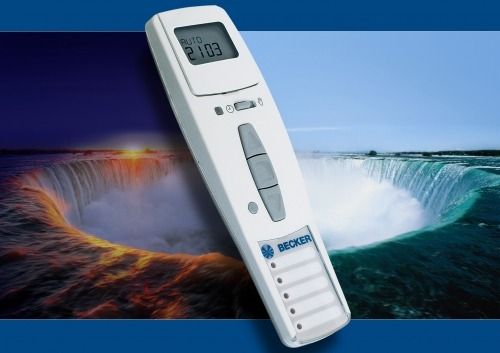
Motorised awnings use quiet electric motors — typically Somfy or Rollease Acmeda — that operate via remote, wall switch, or smartphone app.
Motorised vs Manual Retractable Awnings: Honest Comparison
| Feature | Manual Retractable Awning | Motorised Retractable Awning |
|---|---|---|
| Operation | Hand crank — physical effort required | Remote, wall switch, or app — one touch |
| Entry Price (installed) | From ~$1,200 | From ~$1,600–$2,000 |
| Wind Sensor Compatible | ✗ Not compatible | ✓ Compatible |
| Sun Sensor Compatible | ✗ Not compatible | ✓ Compatible |
| Smart Home Integration | ✗ Not available | ✓ Google Home, Alexa, HomeKit |
| Suitable for Large Spans (5m+) | ⚠ Difficult to operate | ✓ Effortless operation |
| Works in Power Outage | ✓ Always works | ✓ Manual override / battery option |
| Suitable for Accessible Use | ✗ Physical limitation | ✓ Fully accessible operation |
| Timer / Schedule Function | ✗ Not available | ✓ Programmable |
| Maintenance Complexity | Low (mechanical only) | Low-Medium (motor + mechanical) |
| Warranty (motor) | N/A | 5–7 years (Somfy / Rollease Acmeda) |
| Recommended for Melbourne? | ⚠ Budget-first option | ✓ Strongly recommended |
Somfy vs Rollease Acmeda: Which Motor Brand Is Best for Melbourne Awnings?
This is one of the most-asked questions in Australian awning forums and Reddit threads — and frustratingly, most answers are influenced by what the answering installer happens to stock. Here’s a balanced look at both leading motor systems, with equal coverage of each.
Somfy — The Global Benchmark
Somfy is the world’s largest manufacturer of motors for interior and exterior shading products, with more than 50 years of engineering history. Their motors are widely regarded as the industry standard for quality and reliability in Australian motorised awning installations.
- Whisper-quiet operation — typically 35–38 dB at 1 metre
- Built-in thermal overload protection prevents motor burnout
- Somfy TaHoma smart-home hub integrates with Google Home, Amazon Alexa, Apple HomeKit, and SmartThings
- Eolis wind sensor — the gold-standard wind detection accessory for Melbourne’s storm conditions
- Sunis sun sensor — automated sun tracking for hands-free operation
- 5-year warranty on most residential motor lines
- Extensive Australian service network for repairs and replacements
Rollease Acmeda — The Australian-Made Choice
Rollease Acmeda is an Australian-owned manufacturer headquartered in Sydney, with significant manufacturing operations in Australia. Their Automate platform is a genuine competitor to Somfy’s TaHoma ecosystem and is increasingly specified by Melbourne installers for its local support advantage and competitive pricing.
- Australian-designed motors optimised for local climate conditions and power supply standards
- Automate platform — full smart-home integration with Google Home, Amazon Alexa, and Apple HomeKit
- Battery-powered motor options (no mains wiring required) — significant advantage for post-construction retrofit installations
- Wind and sun sensor compatibility across most motor lines
- Strong local warranty and service support — meaningful advantage in Melbourne’s competitive installer market
- 5-year warranty on select motor ranges
Bottom Line: Both Somfy and Rollease Acmeda are excellent choices for Melbourne motorised awnings — the “best” option depends primarily on your smart-home ecosystem preference and your installer’s certification level with each platform. Ask your installer which platform they’re best trained on and can fully support post-installation.
Motorised Awning Smart Home Compatibility (2026)
Choosing the Right Outdoor Awning for Your Melbourne Home or Business
Not all outdoor awnings are created equal — and the right choice depends on your specific space, budget, usage, and aesthetic. Here’s a practical guide to the main awning types available across Melbourne’s residential and commercial market in 2026:

Motorised Folding Arm Awnings
Wall-mounted retractable awnings with motorised operation. The most popular residential awning choice in Melbourne — available in spans up to 10m+ with LED, wind sensor, and smart-home integration options.

Canopy Awnings Melbourne
Fixed-front retractable awnings where the front bar remains stationary. Ideal for window shading, shopfronts, and heritage homes. Available with branding options for commercial Melbourne applications.

Commercial Awnings Melbourne
Heavy-duty motorised awning systems for Melbourne cafes, restaurants, retail, and office buildings. Custom fabrication, corporate branding, and multi-span installations available.
How Much Do Motorised & Retractable Awnings Cost in Melbourne? (2026 Price Guide)
Let’s talk money — because the price guides floating around online are frequently 2–3 years out of date and don’t account for the current cost of aluminium extrusions, motor components, or Melbourne installation labour. Here’s an honest, current breakdown:
Up to 3m wide × 2m projection. Basic acrylic fabric, powder-coated frame. Manual crank operation.
Up to 3m wide. Somfy or Rollease motor, remote control included. Entry-level motorisation.
3–5m wide × 2.5m projection. Quality acrylic fabric, motorised with remote. Wind sensor add-on available.
5–8m wide × 3m projection. Premium motor, cassette housing option, sensor integration.
Multi-span, commercial-grade systems. Heavy-duty motors, branding options, council compliance.
What Affects the Final Price of Your Motorised Awning?
- Size (width × projection): The single biggest cost driver. Every extra metre of width adds fabric, extrusion material, and motor load requirements.
- Fabric quality: Entry-level polyester fabrics vs premium solution-dyed acrylics (Dickson, Sunbrella, Serge Ferrari) — a quality fabric costs more upfront but lasts significantly longer under Melbourne’s UV intensity.
- Motor brand and specification: Somfy Sonesse vs RTS vs Connexoon; Rollease Acmeda standard vs Automate — pricing varies by motor torque rating and smart-home capability.
- Sensor package: Add $180–$450 for a wind sensor; $200–$500 for a sun sensor; $350–$700 for a combined smart sensor hub.
- Cassette or open-roll housing: Cassette awnings (fully enclosed mechanism) add $300–$800 to the base price but significantly extend fabric life by protecting from UV and dust when retracted.
- Wall substrate: Installation into brick or concrete is standard; installation into lightweight steel frames, Hebel, or render over foam may require specialist fixing — this can add $150–$400 in labour.
- LED lighting: Integrated LED strip in the front valance adds $300–$600 to most motorised setups.
Value Tip: The cheapest motorised awning isn’t always the cheapest over time. A $1,600 motorised awning with a no-name motor and untreated polyester fabric may need replacement fabric at year 4–5 and motor replacement at year 6–8 under Melbourne’s UV conditions. A $2,800 awning with a Somfy motor and solution-dyed acrylic fabric will frequently outlast two replacement cycles on the cheaper unit. Ask Lifestyle Awnings for a like-for-like comparison on your specific requirements.
How Do Retractable Awnings Handle Melbourne’s Weather? (The Honest Answer)
Melbourne’s outdoor products have to deal with conditions that few other Australian cities combine in the same package: high UV intensity, strong westerly and north-westerly winds, occasional hail, coastal salt air in bayside suburbs, and temperatures ranging from sub-zero frosts in some outer suburbs to 44°C+ heatwaves. Here’s an honest look at what retractable awnings can and can’t do across each of these conditions.
| Melbourne Condition | Retractable Awning Performance | Recommendation |
|---|---|---|
| High UV (Index 11–13, Nov–Mar) | ✓ Excellent — up to 94% UV block | Solution-dyed acrylic fabric (Dickson, Sunbrella); UPF 50+ rated |
| Summer Heat (38–44°C) | ✓ Excellent shade and surface cooling | Light/reflective fabric colours for maximum heat reflection; shade north/west exposures |
| Strong Winds (60–90 km/h gusts) | ⚠ Retract when winds exceed 45 km/h | Somfy Eolis or Rollease wind sensor for automatic retraction — essential for north/west facing |
| Heavy Rain | ⚠ Moderate — pitch-dependent drainage | Minimum 15° pitch; retract during heavy rain to prevent pooling and fabric stress |
| Hail | ✗ Retract before hail events | Weather radar monitoring; motorised + wind sensor for rapid automated retraction |
| Coastal Salt Air (Bayside Suburbs) | ✓ Good with correct specification | Marine-grade powder coating on frames; 316 stainless steel fixings; quarterly rinse cycle |
| Winter Sun (lower UV, cooler temps) | ✓ Retract to maximise solar warmth | The retractable advantage: open sky in winter = free passive heating for your alfresco |
Melbourne Wind Reality Check: Melbourne’s Bureau of Meteorology records show summer storm cells regularly produce gusts of 70–90 km/h over metropolitan areas — well above the 45 km/h operational limit of most folding arm awnings. This is precisely why a wind sensor is not optional for Melbourne — it’s the single most important accessory for protecting your awning investment. Check live Melbourne wind forecasts at bom.gov.au if you prefer to monitor manually, but automated protection is strongly recommended.
Commercial Awnings Melbourne: Cafes, Restaurants, Retail & Office Buildings
Commercial awnings in Melbourne serve a dual purpose that residential awnings don’t: they’re simultaneously functional shade infrastructure and brand-visible marketing assets. Melbourne’s hospitality and retail strip culture — from Brunswick to South Yarra, Fitzroy to St Kilda — makes a well-specified commercial awning one of the most commercially visible investments a business can make in their shopfront or alfresco precinct.
Commercial Awning Types for Melbourne Businesses
- Retractable folding arm awnings (commercial grade): Heavy-duty motorised systems with reinforced arms, higher wind ratings, and larger span capabilities — suitable for restaurant alfresco areas up to 15m+ wide
- Fixed canopy awnings: Permanently projected canopies above shopfronts — structural, weather-resistant, and ideal for brand printing. Common throughout Melbourne’s CBD and inner-suburban retail strips
- Motorised drop-arm awnings: Hybrid systems where the arm angle can be motorised independently, allowing solar tracking throughout the day — increasingly popular in Melbourne’s upmarket hospitality sector
- Barrel / bullnose awnings: Traditional curved awnings — iconic on Melbourne’s heritage retail strips and café laneways. Available in both fixed and retractable configurations
- Tensioned shade structures: Engineered fabric canopies for large commercial outdoor areas — sporting venues, function centres, and hotel pool decks
Do Commercial Awnings in Melbourne Require Council Approval?
Unlike most residential awning installations, commercial awnings in Melbourne frequently do require council planning approval. Under the Victorian Planning Provisions, businesses in activity centres, heritage precincts, or on classified roads are generally required to obtain a planning permit before installing signage, awnings, or any structure visible from the street. Your local council’s planning department (or a qualified planning consultant) can advise on the specific requirements for your property.
Commercial motorised awnings expand Melbourne hospitality and retail spaces into productive, all-weather alfresco areas — one of the city’s most profitable outdoor investments.
What to Expect: The Motorised Awning Installation Process in Melbourne
If you haven’t had an awning installed before, understanding what the process looks like helps set expectations and ensures you ask the right questions when getting quotes. Here’s the typical journey from first enquiry to installed awning in Melbourne:
-
1
Measure & Consultation (Usually Free)
A qualified installer visits your property to measure the installation area, assess the wall substrate (brick, render, timber, steel), confirm access for power (for motorised systems), and discuss fabric, colour, and feature options. Lifestyle Awnings offers this as a complimentary service across Melbourne.
-
2
Quote & Design Selection
You receive a detailed written quote covering supply, installation, and any accessories. Fabric and colour samples are provided. Motorised system options — motor brand, remote type, sensor package, smart-home hub — are confirmed at this stage.
-
3
Custom Manufacture
Your awning is custom-made to the confirmed measurements — typically a 2–5 week lead time depending on fabric availability and workshop capacity. All Lifestyle Awnings systems are made to measure, not off-the-shelf.
-
4
Installation Day
Installation typically takes 2–6 hours for a standard residential motorised awning. The team mounts the wall bracket, installs the awning arm system, connects the motor to power (typically a GPO or hardwired connection via a licensed electrician), configures limits and sensor settings, and commissions the smart-home integration if included.
-
5
Handover & Operation Training
Your installer walks you through operation of the remote, wall switch, app setup, and sensor configuration. All warranty documentation is provided. Most quality Melbourne installers include a 12-month workmanship warranty alongside the product warranty.
Can I Install a Retractable Awning on Any Wall Type?
Most Melbourne homes — brick veneer, double brick, rendered block, and timber framing — are suitable for retractable awning installation with appropriate fixings. The key considerations are:
- Brick or masonry: Standard expansion bolt fixings — the most common and straightforward installation type in Melbourne’s suburban housing stock
- Render over brick: Fixings drill through render into masonry below — not a significant complication
- Timber framing (weatherboard): Must fix into structural frame members (studs), not just cladding — requires a stud finder and careful fixing layout
- Hebel / AAC panel: Requires specialist fixings rated for the lower shear strength of autoclaved aerated concrete — always confirm with your installer
- Lightweight steel frame: Similar to timber — requires fixing into structural members, not cladding skin
How to Maintain Your Motorised Retractable Awning in Melbourne
One of the most searched-for questions about retractable awnings in Melbourne — and one of the worst-answered online — is maintenance. Here’s a practical, Melbourne-specific schedule that will genuinely extend the life of your awning:
Monthly Checks (5 Minutes)
- Brush debris (leaves, pollen, bird droppings) from fabric with a soft broom — don’t let debris sit and break down fabric fibres
- Inspect fabric for any abrasion marks at the roller or arm contact points
- Run the awning through its full extend/retract cycle to check for unusual noise or uneven movement
Every 3–6 Months
- Rinse the fully extended fabric with clean water from a hose — removes accumulated salt, pollution, and particulates (especially important in Melbourne’s bayside suburbs)
- Apply a light silicone lubricant (not WD-40, which leaves residue) to pivot points on the folding arms and the axle bearings
- Check all wall fixings for movement or corrosion — tighten if necessary
- Inspect motor connections and sensor wiring for any weather damage
Annual Service
- Full fabric clean with a mild soap solution approved for awning fabrics (avoid bleach — it degrades UV inhibitors in acrylic fabrics)
- Professional service inspection — arm tension adjustment, motor limit re-calibration, sensor function test
- Check fabric tension — retract and re-extend at full extension several times to assess even tension across the width
- For cassette awnings: inspect the housing seals for UV degradation and replace if cracking
What Not to Do: Never use a pressure washer directly on awning fabric — the high-pressure water jet forces water into the weave structure and can degrade the fabric faster than UV exposure. Never use bleach or strong detergents on acrylic fabrics. And never leave a motorised awning extended during Melbourne storm warnings — even with a wind sensor, extended exposure to sustained strong winds adds cumulative stress to the fabric and arm mechanism.
Frequently Asked Questions: Motorised & Retractable Awnings Melbourne
Motorised retractable awnings in Melbourne typically cost between $1,600 and $6,500 fully installed for residential applications in 2026. The mid-range sweet spot — a 3–5m wide motorised folding arm awning with a quality Somfy or Rollease motor and premium acrylic fabric — generally falls in the $2,400–$3,800 range. Commercial and large-span systems start from $5,000+. Request a free Melbourne measure and quote from Lifestyle Awnings for pricing specific to your space.
Yes — but the key is specifying correctly for Melbourne conditions. A motorised awning with a wind sensor will automatically retract when winds exceed your set threshold, protecting your investment from Melbourne’s summer storm gusts. Without a wind sensor, you need to manually retract during strong wind events. The flexibility of a retractable awning — shade when you need it, clear sky during storms and cold snaps — makes it significantly more practical for Melbourne’s variable climate than any fixed shade structure.
“Retractable awning” refers to any awning that can extend and retract — this includes both manual (hand-crank) and motorised variants. A “motorised awning” is a retractable awning specifically fitted with an electric motor for powered operation. All motorised awnings are retractable, but not all retractable awnings are motorised. The upgrade from manual to motorised adds smart-home compatibility, wind and sun sensor integration, and effortless one-touch operation.
Yes. Motorised awnings fitted with Somfy motors integrate with Google Home, Amazon Alexa, and Apple HomeKit via the Somfy TaHoma smart-home hub. Rollease Acmeda’s Automate platform offers equivalent compatibility. Once connected, you can control your awning by voice command (“Hey Google, extend the awning”), schedule automatic operation, and integrate it with other smart-home devices and scenes. Ask your installer to confirm smart-home compatibility before purchase.
Most motorised awnings include a manual override crank that allows operation during a power outage. Rollease Acmeda offers battery-powered motor variants that require no mains wiring at all — these are ideal for Melbourne homes where running power to the awning location is impractical or expensive. Somfy also offers battery-powered options for specific motor lines. Confirm the power-outage contingency with your installer before committing.
Most standard residential retractable awning installations in Melbourne do not require a planning permit under Victoria’s permitted development provisions. However, properties in heritage overlay zones, apartment buildings governed by owners corporations, and commercial premises on classified roads typically do require council approval. Always confirm requirements with your local council’s planning department or ask your installer to check on your behalf. The Victorian Building Authority (VBA) also maintains guidance on building permit requirements for attached structures.
Technically yes — but it’s not recommended practice in Melbourne, particularly from October through March when overnight storms are most frequent. The risk is that a storm develops overnight when the awning is extended and unattended. A wind sensor provides automated protection in this scenario — the awning retracts automatically when wind speed exceeds the threshold. Without a wind sensor, the safest practice is to retract the awning before going to sleep or leaving the home during storm season. Many Melbourne insurers also specify that awnings must be retracted during high-wind events to maintain cover for storm damage claims.
Solution-dyed acrylic fabrics — such as Dickson Orchestra, Sunbrella, and Serge Ferrari Batyline — are the recommended specification for Melbourne conditions. Solution-dyed means the colour is embedded in the fibre during manufacture rather than applied to the surface, making it significantly more resistant to UV-induced fading under Melbourne’s high UV index. These fabrics also offer UPF 50+ protection, water resistance, and mould resistance — all important for Melbourne’s climate. Avoid untreated polyester fabrics in Melbourne’s UV conditions: they typically fade noticeably within 2–3 years.